Healthcare organizations are navigating one of the most financially complex environments in any industry. Rising labor and supply costs, ongoing supply chain disruption, fragmented data, and the shift to value-based care have made spend management more critical than ever. As these pressures intensify, the Chief Financial Officer (CFO) is increasingly stepping into a more strategic role and leading transformation efforts that align financial discipline with clinical and operational priorities. Gaining insight into spend excellence in healthcare and understanding how financial, clinical, and operational decisions intersect can help leaders reduce inefficiencies, improve patient outcomes, and build long-term financial sustainability.

Defining Spend Excellence in Healthcare
Spend excellence goes beyond cost reduction and is defined as the optimization of expenditures to improve clinical outcomes and operational performance. Rather than focusing solely on cutting costs, organizations must ensure that every dollar spent delivers measurable value.

This approach requires cost transparency, alignment between clinical and financial priorities, and disciplined, data-driven decision-making. When executed effectively, spend management enables organizations to better understand not just how much they spend, but why and what value that spend produces.
Healthcare Cost Pressures and Spend Management Challenges
Healthcare organizations face a convergence of financial pressures that continue to strain margins and limit investment in care delivery. Rising labor costs, persistent supply chain instability, and increasing expenses tied to care delivery have made procurement more complex and less predictable.

At the same time, many organizations still operate with fragmented data systems and inefficient purchasing processes, limiting visibility into total spend. As the industry shifts toward value-based care, leaders are expected to reduce costs while improving outcomes—a difficult balance without a strong healthcare spend management strategy. If left unaddressed, these challenges can lead to unsustainable margins, delays in care delivery, and increased reliance on high-cost, short-term purchasing strategies.
The CFO’s Evolving Role in Spend Management Strategy
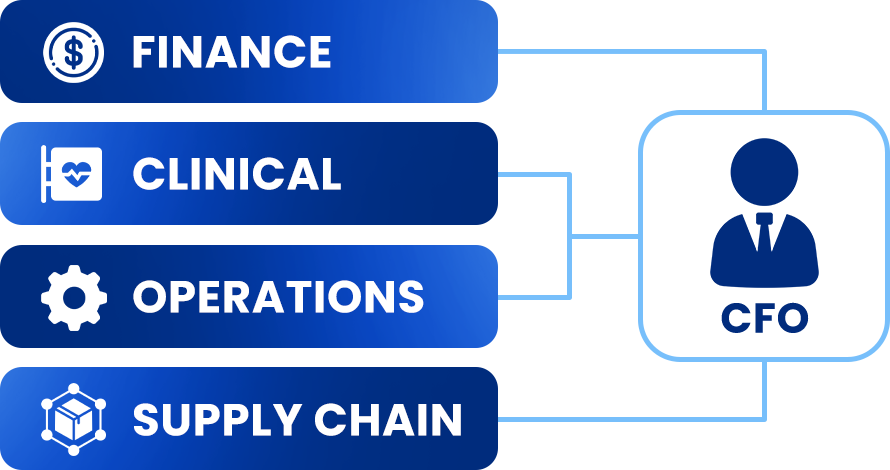
The role of the CFO has evolved far beyond traditional financial oversight. Today’s CFO is a strategic leader responsible for driving spend excellence across the organization. This includes optimizing capital allocation across IT, infrastructure, and clinical systems; managing financial and supply chain risk; and aligning stakeholders across finance, operations, and clinical teams. Perhaps most importantly, the CFO serves as a change leader, ensuring that spend management strategies are embedded across the enterprise and tied directly to patient-centered outcomes. This shift positions the CFO as a central architect of both financial resilience and operational performance.
Four Pillars of Spend Excellence
Achieving sustainable spend excellence in healthcare requires a structured approach built on four core pillars:
- Data transparency and analytics to identify cost drivers and enable informed decision-making.
- Strategic procurement that prioritizes long-term value over transactional purchasing.
- Clinician engagement to align utilization with both quality outcomes and financial performance.
- Value-based decision-making focused on total cost of care, ensuring that financial decisions support broader organizational goals.
Together, these pillars form the foundation of effective healthcare spend management, helping organizations reduce variation, improve outcomes, and control costs.

Enabling Spend Excellence Through Technology
Technology plays a critical role in advancing spend excellence in healthcare. Modern ERP platforms such as SAP, Oracle, and Workday provide financial visibility and control, while specialized analytics tools help identify variation, benchmark performance, and uncover savings opportunities.
More advanced capabilities, including AI-driven predictive modeling and supply chain dashboards, allow organizations to anticipate demand, manage risk, and make proactive decisions. These tools give CFOs the insights needed to lead more effective spend management strategies at scale.
Driving Results: A Roadmap for CFOs
Organizations that prioritize spend excellencecan achieve meaningful, measurable results. In one example, a health system partnered with Ovation to realize $8 million in annual savings, reduce supply variation by 15%, and implement a three-year transformation strategy led by the CFO in partnership with clinical leadership.
Achieving these outcomes requires a clear and disciplined approach. Leading CFOs begin with a comprehensive assessment of current spend, followed by building cross-functional alignment across finance, supply chain, and clinical teams. Investment in scalable analytics tools enables transparency and accountability, while clearly defined KPIs, such as total cost of ownership and realized savings, ensure progress is measurable and sustained. Over time, this approach helps embed spend management into the organization’s culture, rather than treating it as a one-time initiative.
Advancing Organization-Wide Spend Excellence
Spend excellence in healthcare is essential to delivering better outcomes, improving efficiency, and maintaining financial resilience. CFOs are uniquely positioned to lead this transformation by aligning strategic vision, operational discipline, and cross-functional collaboration. By advancing spend management strategies that prioritize value and outcomes, they ensure every dollar spent supports both organizational performance and high-quality patient care.