AI in revenue cycle management is rapidly reshaping how healthcare organizations respond to growing financial and operational pressures. With limited staff, increasing administrative complexity and rising denial rates, hospitals are being pushed to do more with fewer resources. As organizations look for scalable solutions, AI in RCM offers a path to improve access to care, reduce administrative burden and strengthen financial performance without overextending teams.
The Growing Strain on Revenue Cycle Operations
Healthcare RCM has always been complex, but today’s environment has intensified the challenge. Workforce shortages, tighter margins and increasing payer requirements are contributing to inefficiencies across the revenue cycle. Manual processes, such as eligibility verification, coding, prior authorization and claims management, are driving delays, denials and lost revenue.
For rural hospitals, these challenges are even more pronounced. Limited staffing and fewer specialized resources make it difficult to keep pace with evolving payer rules and administrative demands. As a result, many organizations are turning to AI in RCM to stabilize operations and improve outcomes.
Automation vs. AI in Revenue Cycle Management
While often used interchangeably, automation and AI serve distinct roles within RCM. Automation focuses on rule-based, repetitive tasks such as claim status checks or payment posting. It improves efficiency by reducing manual effort but operates within predefined workflows.
AI, on the other hand, introduces learning and adaptability. AI can analyze patterns, predict outcomes, and make data-driven recommendations. For example, AI-powered tools can identify denial trends, prioritize high-risk claims and suggest corrective actions before submission. Understanding this distinction is critical for healthcare leaders looking to build a more intelligent and resilient revenue cycle strategy.
Key Applications of AI in Reducing Administrative Burden
AI in RCM is already delivering measurable impact across several core functions:
- Denial prevention and management: Predictive analytics identify claims likely to be denied, enabling proactive intervention.
- Prior authorization optimization: AI streamlines documentation requirements and accelerates approval workflows.
- Medical coding and charge capture: Natural language processing (NLP) improves coding accuracy and reduces rework.
- Patient access and eligibility: Automated verification tools reduce front-end errors that lead to downstream denials.
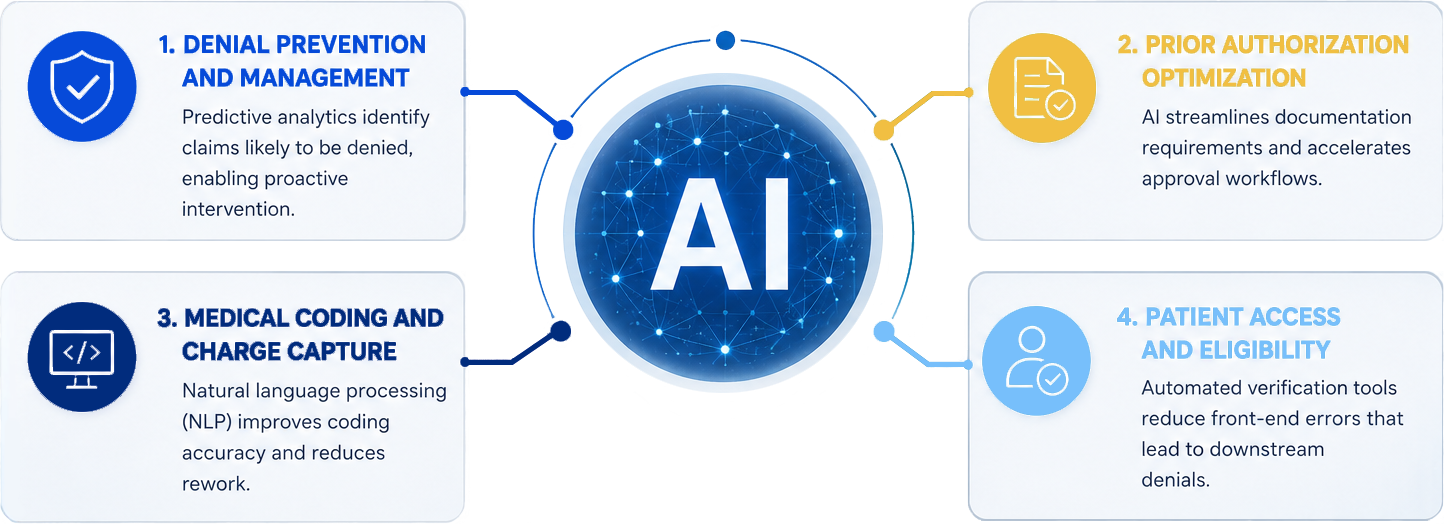
By addressing inefficiencies at multiple points in the revenue cycle, AI helps reduce administrative burden while improving cash flow and patient access.
Implementing AI to Improve RCM Performance
Successfully implementing AI in RCM requires a strategic approach. Organizations should begin by identifying high-impact areas where administrative inefficiencies are most costly, such as denial management or prior authorization.
From there, aligning technology with existing workflows is essential. AI solutions should complement, not disrupt, current operations. Engaging cross-functional stakeholders across finance, IT, and clinical teams supports smoother implementation and drives more sustainable outcomes.
Equally important is establishing clear performance metrics. Tracking KPIs such as denial rates, days in accounts receivable, and cost to collect helps quantify the impact of AI investments and guide continuous improvement.
Tailoring AI Strategies for Rural Hospitals
For rural hospitals, adopting AI in RCM isn’t only about innovation, it’s about sustainability. Limited staffing, tighter operating margins, and reduced access to specialized RCM expertise make it difficult to maintain consistent financial performance. AI offers a practical way to extend capabilities without adding headcount.
One of the most impactful strategies is prioritizing front-end revenue cycle improvements. AI-driven eligibility verification and prior authorization tools can significantly reduce downstream denials—an area where rural hospitals often face avoidable revenue loss. Similarly, AI-powered denial prediction models can help staff focus on high-risk claims, ensuring limited resources are directed where they matter most.
Ultimately, AI empowers rural hospitals to operate more efficiently, protect revenue and continue delivering essential care to underserved communities.
Building a More Resilient Revenue Cycle

The future of healthcare financial performance will depend on how effectively organizations adapt to rising complexity, and AI in RCM is quickly becoming a differentiator. Organizations that take a strategic, phased approach to adoption, grounded in clear priorities and measurable outcomes, will be best positioned to succeed. By leveraging AI in RCM to enhance decision-making, optimize workflows and reduce friction across the patient financial journey, hospitals can strengthen both operational performance and patient access in a rapidly changing healthcare landscape.
Thank you to Ovation Healthcare’s SVP of Enterprise Operations, Glenda Tankersley, for her valuable insights and contributions to this article.